
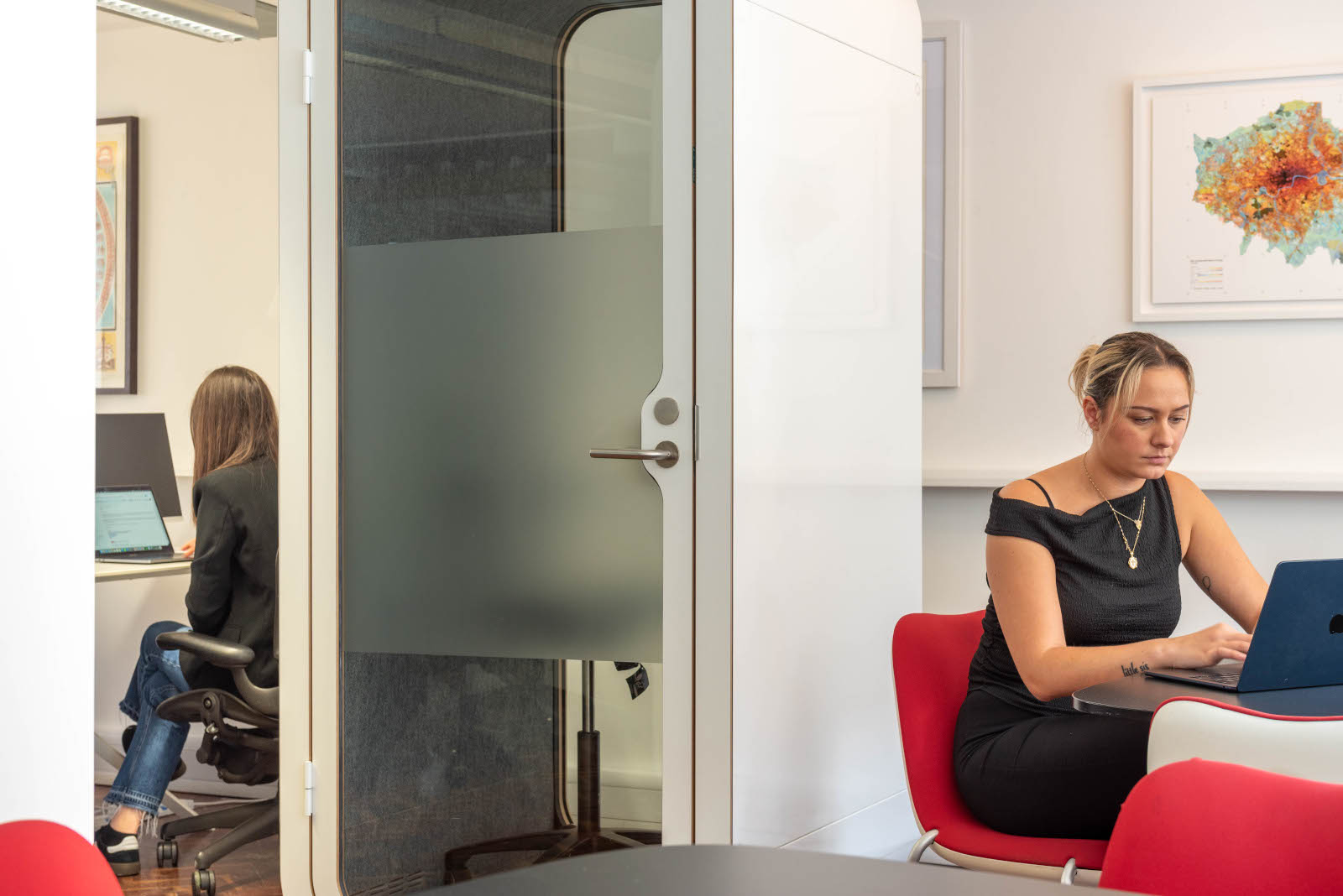
Hybrid work has changed how London professionals use offices. Many people now split their week between home and the city; London residents report some of the highest levels of hybrid working in Great Britain, with around four in ten workers both travelling to a workplace and working from home over a typical period. (Source: Office for National Statistics)
When you do come into town, you are usually looking for one thing above all else: reliable focus. Yet research consistently finds that noise and lack of speech privacy are among the largest contributors to environmental dissatisfaction in open-plan offices, directly affecting perceived productivity and wellbeing. (Source: ISO 3382-3:2022) A case study of four modern offices led by University College London similarly found that noise is the most frequent reason for complaints about workplace conditions. (Source: UCL Discovery)
If you are paying for an office day pass and still battling the same distractions you have at home, something has gone wrong.
This is where a quiet-first office day pass comes in. Instead of treating acoustics as an afterthought, a quiet-first operator bakes noise control into the way the building is chosen, designed, zoned and run. In this piece, we will unpack what “quiet-first” really means, how to evaluate noise when you book any flexible office day pass, and how eOffice applies these principles across its network of central London workspaces.
The World Green Building Council has pulled together extensive evidence that office design – including acoustics – has a measurable impact on staff health, wellbeing and productivity, noting that being productive in a modern knowledge office is “practically impossible” when noise is a constant distraction. (Source: World Green Building Council)
Systematic reviews comparing open-plan and cellular offices reach similar conclusions: open-plan layouts are often associated with more complaints about noise, reduced privacy and lower self-rated performance, despite their space-saving advantages. (Source: SAGE Journals – A Comparison of Psychological and Work Outcomes in Open-Plan and Cellular Office Designs) Survey-based research on irrelevant speech noise has linked chatter in shared offices with increased annoyance, reduced perceived productivity and poorer mental wellbeing. (Source: International Journal of Environmental Research and Public Health)
For hybrid workers who choose specific “in-office” days to concentrate, that trade-off is even starker: if your office day is noisy, you have effectively wasted the one day you earmarked for deep work.
Modern acoustic standards treat open-plan offices as measurable sound environments, not just a matter of taste. ISO 3382-3, the key standard for open-plan offices, defines parameters for room acoustic quality and emphasises the role of background sound level, sound-absorbing surfaces and screens in controlling speech noise over distance. (Source: ISO)
Contemporary design guides drawing on British Standard BS 8233 and ISO 3382-3 suggest that:
Below these levels, the space can feel unnervingly quiet – every keyboard tap or chair movement becomes a distraction. Above them, intelligible speech and ringing phones dominate your attention. The goal for a quiet-first office is controlled, consistent background sound, not an unrealistic promise of total silence.
A quiet-first office day pass is not just “a desk that happens to be in a nice building”. It reflects three layers of thinking:
In effective open-plan offices, the acoustic performance of the space is designed, not left to chance. ISO 3382-3 highlights how room geometry, the amount and placement of wall and ceiling absorption, workstation screens, furniture and background sound level all combine to shape speech privacy and noise perception. (Source: ISO 3382-3:2022)
From a day-pass user’s perspective, that translates into practical questions:
You may never see the specification, but you will feel the result the moment you sit down.
Coworking design guides increasingly recommend zoning a floor plan by activity: focus desking, collaboration zones, café areas, phone booths and meeting rooms, each with its own acoustic expectations. (Source: Spacebring – Coworking Space Design Guide) Well-run spaces back this up with phone booths and sound-dampened meeting rooms so that calls and group discussions do not spill into quiet areas. (Source: Mindspace – Coworking Etiquette)
In practice, a quiet-first day pass usually gives you access to:
The mix lets you match the space to the task without leaving the building.
Even the best acoustic design can be undone if everyone takes hour-long Zoom calls from an open desk. Coworking etiquette guides now treat quiet zones and phone booths as default expectations: calls should move to booths or meeting rooms, and library-style areas are for heads-down work only. (Source: Day Pass Coworking – Coworking Etiquette)
Quiet-first operators tend to:
When you talk to any workspace, how they answer questions about noise rules is often the clearest signal of whether they genuinely prioritise focus.
A quiet office day pass is a one-day, no-contract ticket to a workspace where the environment is deliberately managed for low, predictable noise, with clear options (quiet zones, phone booths, private rooms) when you need more control.
Day passes in the UK generally give you access to a professional workspace for a single day – often a hot desk in a shared area – with Wi-Fi, kitchens and some access to phone booths or breakout space, without any monthly membership. (Source: Spacepool – Day Passes in London)
A quiet-first day pass goes further by explicitly designing and communicating around noise: where you can take calls, where you can expect “library rules”, and how to move into more private space if you need it.
Whether you book with eOffice or another provider, a bit of due diligence on acoustics turns a random desk booking into a reliable focus day.
Because noise and lack of privacy are so tightly linked to dissatisfaction in open-plan offices, reputable design guides and standards now specify target background noise levels and recommend clear acoustic zoning. (Source: World Green Building Council – Health, Wellbeing & Productivity in Offices)
When you contact a space about a quiet flexible office space day pass near you, ask:
If the team cannot answer these questions, it is a red flag for anyone needing a quiet work environment in central London.
If your day involves important video meetings, you are not just looking for a quiet desk; you need sound-insulated rooms so you can speak freely without disturbing others.
Look for:
For truly sensitive conversations or back-to-back calls, you may want to skip the shared area entirely and book a day office rental with soundproof meeting rooms or private offices, which we will come back to when we look at eOffice’s own options.
Quiet-first workspaces do not rely on headphones alone. They set expectations about where noise lives.
Well-regarded etiquette guides recommend that:
When you enquire about an office day pass with low noise guarantee for focused work or a day office rental with strict noise policies, listen for concrete answers:
Spaces that talk openly about etiquette and provide the right rooms to back it up are far more likely to deliver the quiet experience you are paying for.
Aggregators and review platforms can reveal what the marketing copy does not. Look for comments that mention words like quiet, calm, noisy or distracting. For example, an independent listing for eOffice HQ Soho on CoworkingCafe describes the environment as “clean, quiet and welcoming,” which is a good external signal that acoustic comfort is taken seriously. (Source: CoworkingCafe – eOffice HQ Soho)
Apply the same filter to any workspace you are considering; it is a fast way to spot whether “quiet” is an isolated compliment or a consistent pattern.
eOffice operates design-led coworking and serviced offices across central London – including Holborn, Mayfair, Soho, Fitzrovia and the Strand – alongside a global eNetwork of hundreds of partner workspaces in more than 60 countries. (Source: eOffice UK, eOffice eNetwork) This combination of local hubs and an international network shapes how its office day passes work.
Many central London offices trade location for noise, sitting directly on major roads. eOffice takes a more selective approach.
Across these and other London locations, eOffice positions meeting rooms and offices on quieter side streets off Oxford Street and Regent Street so that you get central postcodes with reduced street-level disruption. (Source: eOffice – Central & East London Meeting Rooms)
A day pass at eOffice Soho gives you more than a chair in an open space. The Soho listing describes the product as a one-day ticket to its coworking workspace, including:
The UK Office Daypass Handbook on eOffice’s own site confirms a similar feature set for Holborn: a day pass there includes an ergonomic desk, super-fast Wi-Fi, access to meeting rooms and phone booths, plus refreshments. (Source: eOffice – UK Office Daypass Handbook)
This means that when you book a flexible office day pass with quiet zones available at eOffice, you can rely on having somewhere appropriate to move for calls, not just a generic shared hall.
Beyond the day-pass inclusions, eOffice’s core coworking design explicitly blends open-plan collaboration with quieter pockets. Its coworking workspace page describes how members can choose between open desks and more private options, including booths, meeting rooms and small “cubby holes” for quiet conversations. (Source: eOffice – Coworking Workspace Solutions)
Hotdesking membership materials likewise highlight the ability to pick between hot desks, breakout areas, lounges or quiet corners depending on your work style, with shared access to meeting rooms and phone booths. (Source: eOffice – London Hotdesking Membership)
In other words, the physical layout already reflects the zoned model that acoustic experts advocate: collaborative areas for social energy, and distinct, furnished spaces for calls and quiet work.
Sometimes you do not just want a quiet desk – you want a private, sound-separated room for your team or for a day of confidential work. eOffice addresses this with a dedicated Day Office product across its London centres.
The Day Office page lists options in Soho HQ, Holborn, Soho, Fitzrovia and Mayfair, each marketed as a private office for your team for a full day with super-fast broadband included. Pricing at the time of writing starts from £44.99 per person per day (excluding VAT) at Soho HQ and Holborn, with higher-capacity, prestige options in Fitzrovia and Mayfair. (Source: eOffice – Day Office in Central London)
For anyone searching for an office day pass for private workspace with minimal noise, these day offices are effectively a bookable, temporary private office: you can close the door, manage your own sound levels and still step out into shared lounges and meeting rooms when you want a change of scene.
If your work takes you beyond London, eOffice’s global eNetwork lets you book day passes and meeting rooms in hundreds of partner workspaces worldwide, all through a single platform. The Day Pass hub outlines a network of more than 300 workspaces and communities in 60+ countries and over 130 cities, including London, Manchester and numerous international hubs. (Source: eOffice – Day Pass Network)
For hybrid consultants, digital nomads or frequent travellers, this means you can apply the same quiet-first criteria – quiet streets, phone booths, meeting rooms and clear noise policies – when booking in other cities, rather than starting from scratch with each provider.
Both options support focused work, but they serve slightly different noise profiles.
A quiet-optimised coworking day pass at eOffice works well if:
Here, Soho or Holborn day passes with access to telephone booths and meeting rooms will usually be sufficient. (Source: eOffice – Soho Day Pass, eOffice – UK Office Daypass Handbook)
A private day office is a better fit if:
Because Day Office products at eOffice give you an enclosed room for the day, with super-fast internet and access to shared facilities, they effectively become noise-controlled project rooms in central London, without the long-term commitment of a traditional lease. (Source: eOffice – Day Office in Central London)
Once you have booked, a few habits will help you get full value from a quiet-first office day pass with private, quiet booths and meeting rooms available.
Total silence is rare outside of specialist libraries or studios. Most experts instead recommend controlled background sound levels in the 40–45 dB LAeq range for open-plan offices, combined with highly insulated rooms for confidential work. (Source: NOVA Acoustics) A quiet-first office day pass aims for that balance, plus clear options (phone booths, meeting rooms, day offices) when you need more isolation.
No operator can guarantee absolute silence, but you can reasonably expect:
eOffice’s combination of quiet side-street locations, design-led interiors and day-pass access to phone booths and private rooms is specifically designed to support that expectation, while still operating as a shared professional environment. (Source: eOffice – Soho Location, eOffice – Soho Day Pass)
Cafés typically have highly variable background noise, limited seating control and no dedicated spaces for confidential calls. By contrast, flexible offices following ISO-informed acoustic guidance target stable background noise levels, use carpets and acoustic finishes, and provide enclosed rooms and booths for speech. (Source: ISO – Open-Plan Offices, NOVA Acoustics)
With eOffice, you also get predictable opening hours and bookable quiet-optimised meeting rooms across multiple central locations. (Source: eOffice – Central & East London Meeting Rooms)
Hybrid workers in London increasingly reserve office days for their most important tasks – strategy sessions, client calls, deep creative work. ONS data shows that hybrid patterns are now a normal part of working life, especially in London, rather than a niche arrangement. (Source: Office for National Statistics)
In that context, noisy, ad-hoc day passes are no longer enough. The bar has shifted to quiet-first flexible office space day passes that take acoustics as seriously as Wi‑Fi and transport links.
eOffice’s approach – quiet side-street locations, multi-zone layouts with phone booths and meeting rooms, and the option to upgrade to private day offices – offers a practical template for what that looks like in real life across central London and beyond. (Source: eOffice – Soho Location, eOffice – Day Office in Central London, eOffice – Coworking Workspace Solutions)
If you are ready to swap improvised, noisy workdays for a noise-controlled, focus-first office day pass in Holborn, Soho or another central London location, your next step is simple: pick your preferred building, choose between a coworking day pass or private day office, and reserve your space online.
From there, you bring the work – and let the space take care of the sound.
Please enter your email address to have access to the office detail.
Please enter your email address to have access to the office detail.
Please enter your email address to have access to the office detail.
Please enter your email address to have access to the office detail.
Please enter your email address to have access to the office detail.
Please enter your email address to have access to the office detail.
Please enter your email address to have access to the office detail.
Please enter your email address to have access to the office detail.
Please enter your email address to have access to the office detail.
Please enter your email address to have access to the office detail.
Please enter your email address to have access to the office detail.
Please enter your email address to have access to the office detail.
Please enter your email address to have access to the office detail.
Please enter your email address to have access to the office detail.
Please enter your email address to have access to the office detail.
If you have any questions, require further information and would like pricing details, please get in touch.