
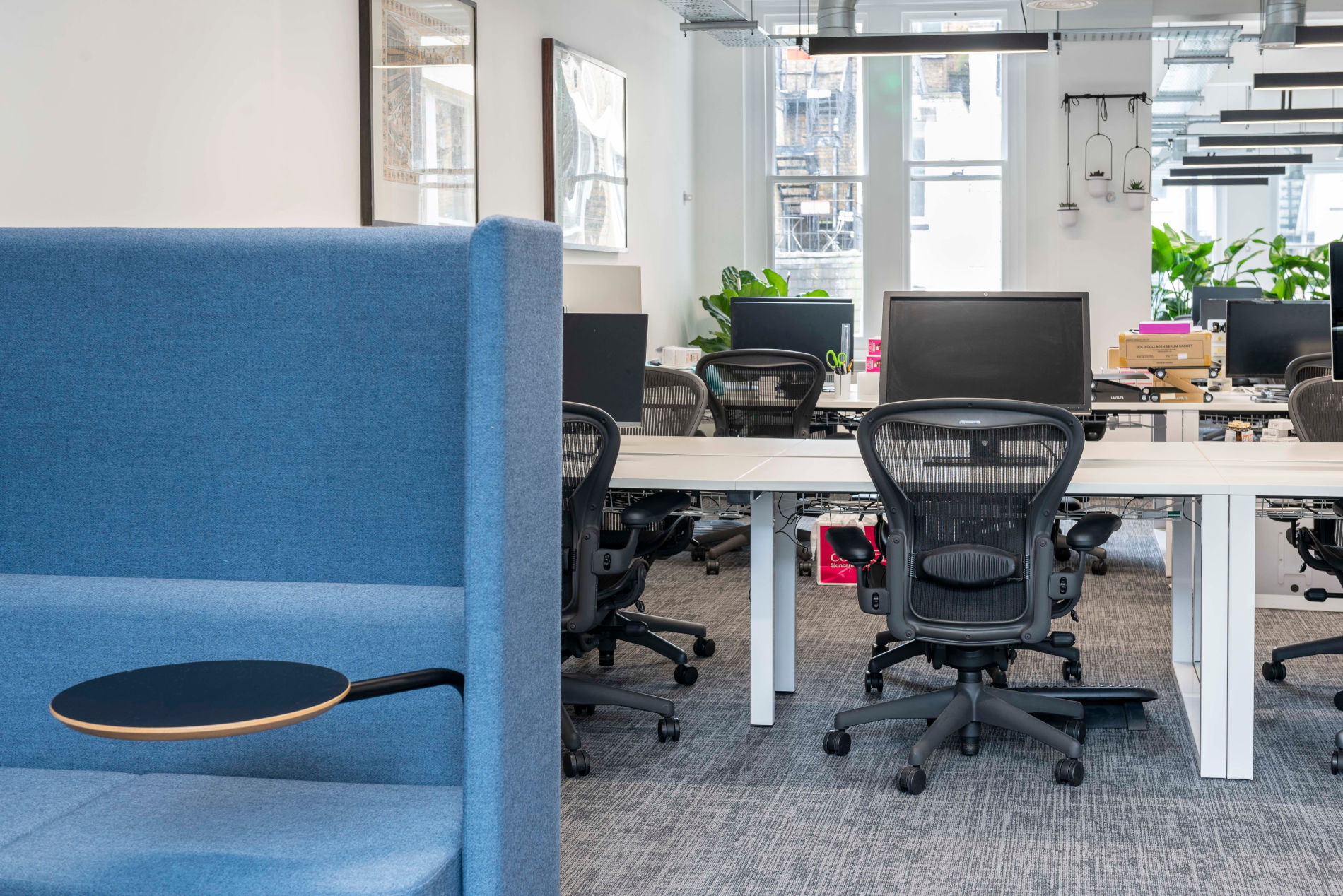
Working out how big your private office should be is surprisingly hard.
You’ll see listings saying things like:
…but is that actually enough room for your team, laptops, coats, visitors and the odd Friday pizza?
This guide is a simple translator between headcount and square footage / square metres for UK teams using flexible private office suites – especially in central London.
You’ll find:
Along the way we’ll use real market benchmarks and examples from eOffice’s own London spaces so this feels grounded in reality, not theory. (Source: HSE; BizSpace; eOffice – Office availability)
There are two different numbers you’ll see in guides:
UK office design benchmarks and the British Council for Offices (BCO) typically land at roughly:
UK health and safety rules also require at least 11 cubic metres of space per person, which in a typical 2.4 m‑high room works out to roughly 4.6 sq m (~50 sq ft) as an absolute minimum. Regulators stress this is a floor, not a target, because it doesn’t account for desks and furniture. (Source: HSE)
In a serviced or flexible office, the quoted sq ft is normally just your private room(s). Shared lounges, kitchens and many meeting rooms sit outside your private sq ft and are not billed against your suite’s size.
That means you can plan a little more tightly inside the office itself:
For most startups and scale‑ups in private office suites, a good rule of thumb is:
The table and examples below assume you’re aiming for that standard 45–55 sq ft/person band inside a serviced private office.
Use this as a first‑pass sense‑check. Sizes are for private suites inside a flexible workspace, not for taking an entire floor on a traditional lease.
How to read this table
– “Approx sq ft” is the typical comfortable range.
– “Approx sq m” is just the same range converted (rounded).
– These figures assume desks plus circulation, with meeting rooms and kitchens mainly in shared areas.
| Team size | Approx private office size (sq ft) | Approx private office size (sq m) | What that comfortably fits |
|---|---|---|---|
| 2 | 100–140 sq ft | ~9–13 sq m | 2 desks, a little storage, space to move; meetings in shared rooms |
| 4 | 180–220 sq ft | ~17–20 sq m | 4 desks in bench layout, coat storage, space for a coffee table or whiteboard |
| 5–6 | 250–300 sq ft | ~23–28 sq m | 5–6 desks plus a small collaboration corner or extra storage |
| 8 | 350–450 sq ft | ~33–42 sq m | 8 desks, some wall storage and perhaps a small soft‑seating area |
| 9–10 | 400–500 sq ft | ~37–46 sq m | Enough for 9–10 people with a clear walkway and perhaps a 2–3 person touchdown table |
| 12–14 | 600–750 sq ft | ~56–70 sq m | 12–14 desks, room for lockers or a high table, with meetings in shared rooms |
| 15–18 | 750–950 sq ft | ~70–88 sq m | Cross‑functional team with 1–2 small breakout spots or phone booths nearby |
| 20 | 900–1,100 sq ft | ~84–102 sq m | 20 desks, space for a couple of small collaboration zones or an internal call room |
| 25–30 | 1,250–1,700 sq ft | ~116–158 sq m | Larger open plan office, scope for internal meeting space and more storage |
| 35–40 | 1,800–2,400 sq ft | ~167–223 sq m | A whole floor or large suite with its own breakout, small meeting rooms and circulation |
You’ll notice these sizes cluster around ~45–55 sq ft per person – nicely in line with common UK rules of thumb of 50–100 sq ft per employee once you include shared facilities. (Source: Tally Workspace; BizSpace)
Let’s make this concrete. Here’s how those sizes feel in real life.
2‑person private office – 100–140 sq ft (≈ 9–13 sq m)
Perfect for two founders or a senior pair who mainly use shared meeting rooms for calls.
Typical layout:
If you’re searching for the smallest private office suite for 2 people, you’ll occasionally see smaller (sub‑100 sq ft) rooms advertised. Technically you can fit two desks, but it will feel cramped and closer to the legal minimums than to a comfortable workspace. (Source: HSE)
5–6 person office – 250–300 sq ft (≈ 23–28 sq m)
This is a sweet spot for early teams looking for flexible office space for 5–6 people.
Inside 250–300 sq ft you can typically fit:
If you’re comparing flexible office space for 5 people and want to know an exact office size, aim for around 250 sq ft (~23 sq m) as a healthy minimum in a serviced environment.
8‑person private office – 350–450 sq ft (≈ 33–42 sq m)
For flexible office space for 8 people, a 350–450 sq ft suite usually gives you:
This matches what many London flexible operators offer for 8–10 desk suites when meeting rooms and kitchens are shared on the floor.
If you want to compare different private office sizes for 8‑person suites, use:
9–10 person office – 400–500 sq ft (≈ 37–46 sq m)
When you step up to private office suites for 9–10 people, a 400–500 sq ft range lets you:
For search phrases like “private office suite for 9 people, what square metre options are available?”, that translates to roughly 37–46 sq m.
12–14 person office – 600–750 sq ft (≈ 56–70 sq m)
At this point you’re into proper team office territory.
A 600–750 sq ft private office for 12–14 people typically supports:
If you’re looking for private office space for 14 with 600 sq ft or more, here’s the simple take:
15–18 person office – 750–950 sq ft (≈ 70–88 sq m)
For flexible office space with private suites for 15–18 people, a 750–950 sq ft range lets you:
People often ask: “Is 800 sq ft enough for a private office for 18 staff?”
20‑person private office – 900–1,100 sq ft (≈ 84–102 sq m)
This is where a lot of London private office searches land: “private office space to rent in London for a team of 20 – specify office size” or “private office suite for 20, is 900 sq ft enough?”
Rules of thumb:
If you know you want 900 sq ft for a 20‑person private office suite, it’s realistic – just budget mentally for heavy use of shared amenities.
For comparison, eOffice currently lists an example 900 sq ft office in Soho HQ for up to 20 people with its own kitchen and meeting room, illustrating that 900 sq ft can work very well for that headcount when the layout is efficient. (Source: eOffice – Office availability)
25–30 person office – 1,250–1,700 sq ft (≈ 116–158 sq m)
For flexible office space with private suites for 30 people, think in this range:
This band is also where managed floors start to make sense – e.g. a self‑contained space with your own kitchen and boardroom.
On eOffice’s availability list you’ll see floors around 1,500–1,700 sq ft marketed for teams of 26–38 people, again landing in the mid‑40s to mid‑50s sq ft per person once you factor in the private kitchen and meeting rooms. (Source: eOffice – Office availability)
35–40 person office – 1,800–2,400+ sq ft (≈ 167–223+ sq m)
For a private office suite for 40 people, your target depends on how self‑contained you want the space to be.
Two useful benchmarks:
A real‑world example: eOffice markets a 2,700 sq ft floor in Soho for up to 40 people, with its own meeting rooms, boardroom, kitchen and large breakout area – an illustration of the more generous end of the range. (Source: eOffice – Office availability)
So if you’re specifically looking for flexible office space for 40 with a private suite around 2,000 sq ft, you’re on the efficient side but still in a workable band, especially in a serviced environment.
Let’s tackle some of the most common “is this enough?” questions head‑on.
If you’re comparing private office space for 14 at 600 sq ft vs 700 sq ft, and budget allows, 700 sq ft will feel materially more comfortable.
Yes – with the right expectations.
If you’d rather run your own numbers, here’s a simple method you can reuse any time your team changes.
Decide how you actually work:
These sit comfortably within broader UK guidance that suggests roughly 50–100 sq ft per employee across different layouts, and BCO‑inspired densities around 10–12 sq m (108–129 sq ft) when you’re fitting out your own leased floor. (Source: BizSpace; Interaction)
Use typical peak in‑office numbers, not total payroll.
Formula:
Required sq ft ≈ Headcount × Target sq ft per person
Example:
Hybrid team of 18, usually 16 people in on the busiest day, planning at 50 sq ft per person:
Most London listings use sq ft; many international teams think in sq m.
Quick conversions:
Handy rounded pairs:
Before you sign anything, check your number against:
As a flexible workspace operator, eOffice spends a lot of time matching team size, sq ft and layout.
Across locations in Holborn, Soho, Soho HQ, Mayfair, Strand and Islington, you’ll see a few consistent patterns:
A few live examples from the availability page illustrate how headcount and sq ft line up in practice:
These examples all sit close to the 45–70 sq ft per person bands discussed above, depending on how much internal amenity is built into the private space.
If you’d like to skip the maths and just say “we’re **18 people now, aiming for 25 within a year – what private office sizes do you have in Holborn or Soho?”, the eOffice team can usually propose 2–3 specific suites or floors that fit your headcount and growth story.
Q. What’s a realistic smallest private office suite for 2 people?
A. Look for 100–140 sq ft (9–13 sq m). Smaller is possible but usually compromises on comfort and storage.
Q. For a 6‑person private office, what exact size should I search for?
A. Target 250–300 sq ft (23–28 sq m). That matches many “6 desk” serviced offices while staying above legal minimums with room for proper desks. (Source: HSE)
Q. What size flexible office space do I need for 8 people?
A. Aim for 350–450 sq ft (33–42 sq m), depending on how much internal breakout space you want.
Q. For a private office suite for 9 people, what square metre options make sense?
A. Roughly 400–450 sq ft, which is about 37–42 sq m, is a good target band.
Q. We’re 15 people now – what size private office suites should we compare?
A. Start around 750 sq ft (~70 sq m), going up towards 900 sq ft (~84 sq m) if you want more storage and informal collaboration space.
Q. We need flexible office space for 18 people, ideally at least 800 sq ft – is that OK?
A. 800 sq ft (~74 sq m) is workable but compact. If budget permits, compare 800 vs 900–950 sq ft and see which layout you prefer.
Q. For 20 people, should we insist on 900 sq ft or push higher?
A. 900 sq ft is a sensible starting point; consider 1,000+ sq ft if everyone will be in most days or you want more internal breakout.
Q. What about private office suites for 30 people – what square metres should we ask providers for?
A. Ask to see options around 1,500–1,800 sq ft, which is roughly 139–167 sq m.
Q. We’re planning for 40 people and see some 2,000 sq ft private offices. Are those realistic?
A. Yes, as long as you’re comfortable using shared meeting rooms and lounges. For a more self‑contained feel, compare those with larger floors in the 2,400–2,800 sq ft range.
Numbers are a great starting point, but nothing beats seeing your team on a real floorplan.
When you book a tour with eOffice in Holborn, Soho, Mayfair, Strand or Islington, the team can:
From there you can decide whether you want to start slightly lean and grow into a larger suite, or secure a more generous space from day one and grow into it.
If you’d like to explore options now, you can start with current availability and then request a tour:
Explore current private office sizes in London
👉 (Source: View eOffice’s London office and coworking availability)
Please enter your email address to have access to the office detail.
Please enter your email address to have access to the office detail.
Please enter your email address to have access to the office detail.
Please enter your email address to have access to the office detail.
Please enter your email address to have access to the office detail.
Please enter your email address to have access to the office detail.
Please enter your email address to have access to the office detail.
Please enter your email address to have access to the office detail.
Please enter your email address to have access to the office detail.
Please enter your email address to have access to the office detail.
Please enter your email address to have access to the office detail.
Please enter your email address to have access to the office detail.
Please enter your email address to have access to the office detail.
Please enter your email address to have access to the office detail.
Please enter your email address to have access to the office detail.
If you have any questions, require further information and would like pricing details, please get in touch.