
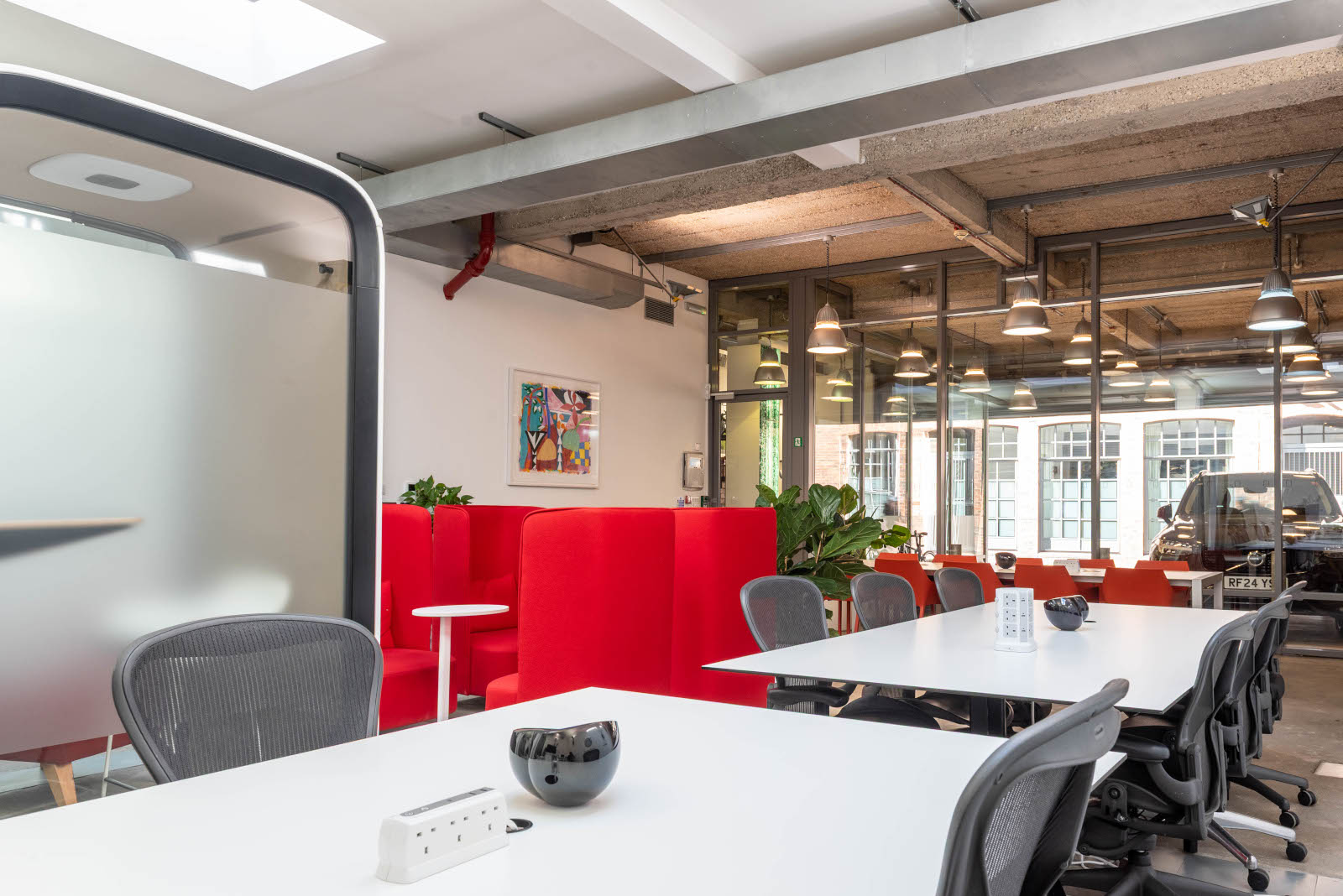
Hybrid working is no longer an experiment in the UK. It is how a large share of people now work, with more than a quarter of working adults in Great Britain splitting time between home and the office as of early 2025 (Source: Office for National Statistics).
If you run a small business, that shift creates a new question:
What kind of hybrid workspace actually fits the way my team commutes?
Proximity to public transport is a big part of the answer. In surveys, UK employees say commuting costs and location convenience are key reasons they choose when to come into the office (Source: The Guardian; Source: Business Insider). Get that right and people are far more likely to use the space you are paying for.
This guide walks through the main hybrid workspace formats, which commuting patterns they suit and how eOffice’s transport linked locations and global network can help you match the right space to your team.
Hybrid workers in the UK now spend around 1.8 days per week working from home on average, higher than the global norm (Source: The Guardian). That means the days they do commute have to feel worth it.
Good transport links help you:
Convenience is not just a nice to have. More than half of UK workers in one survey said that location convenience would influence whether they came into the office at all (Source: Business Insider).
Before you look at any hybrid workspace, sketch out how your team actually travels.
Answer a few quick questions:
With that picture, you can match commuting reality to the right mix of hybrid workspace formats.
Below are the main workspace formats small businesses choose, plus the commuting patterns they suit best.
Best for: Hybrid teams who come in on set days, mainly around London or another major city.
If you have people dotted along Underground or rail lines, an anchor office close to a central Tube hub keeps commute times predictable. This is what many people have in mind when they for flexible office space near London Underground stations for hybrid teams or a hybrid workspace rental close to Tube stations in central London.
What to look for
How eOffice fits
eOffice’s London locations are all in central zones within a short walk of key Underground stations, including Holborn, Chancery Lane, Oxford Circus, Bond Street, Tottenham Court Road, Embankment and Covent Garden (Source: eOffice London). Many are on or close to Oxford Street and High Holborn, so they work well when staff arrive from different corners of London or the South East (Source: eOffice London; Source: HubbleHQ – eOffice Holborn).
For example:
Best for: Remote first teams who only need to gather in person once or twice a month.
If your people are spread across the country, it rarely makes sense to commit to a full time city centre lease. Instead, you can:
This suits use cases like:
How eOffice fits
Through the eOffice global network, you can access flexible offices, coworking spaces and meeting rooms in more than 130 cities worldwide, across 60 plus countries (Source: eOffice Global Locations). That includes UK cities such as Cambridge and Edinburgh among others, many with central locations close to rail and bus links (Source: eOffice Global Locations).
You keep a professional presence where it matters, without paying for an underused full time lease.
Best for: Small teams or individual staff members who come in three to four days a week but live in the same city.
For these people, door to door convenience beats prestige.
Common here include flexible workspace options near major bus routes in London or a hybrid workspace rental close to public transport in Oxford, Nottingham or Leeds.
What to look for
At eOffice’s London sites, coworking desks, hotdesks and shared areas sit within walking distance of some of the city’s busiest bus and Tube interchanges, so staff can swap modes easily depending on the day (Source: eOffice Workspace Solutions).
Best for: Teams where some people drive in from outside town while others rely on train or bus.
This is common for:
Here you want a hybrid workspace with parking and public transport links in places like Leeds, Cardiff, Bristol or Sheffield.
What to look for
Where eOffice does not operate its own space, many of its partner centres in the eOffice network are in business districts with both car access and strong public transport, which you can filter for when you by city (Source: eOffice Global Locations).
Best for: Distributed businesses that rarely need the whole team in one place but still want a credible office presence.
This model works well when you are thinking about hybrid office space with public transport links for remote teams, or flexible hybrid workspaces near public transport for small businesses that mostly work online.
You can:
eOffice offers virtual office services plus on demand meeting rooms and day offices in central London locations like Soho, Holborn, Mayfair, Strand and Fitzrovia, all a short walk from Underground stations (Source: eOffice London; Source: Day Office Soho HQ). From there you can tap into partner centres in other UK and international cities.
| Use Case | Team Commuting Pattern | Recommended Workspace Type | Ideal Transport Links | Example Fit |
|---|---|---|---|---|
| London based hybrid team, 2 to 3 office days | Staff mainly in Zones 2 to 6 on Tube or rail | Private office with flexible terms | 2 to 5 minute walk to multiple Tube lines | eOffice Holborn or Soho near Holborn, Tottenham Court Road and Oxford Circus stations (central London) |
| National team, monthly meetups | People across UK cities, travelling by train | Day office near mainline station | Within 5 to 10 minutes of major rail hub | Book partner spaces near Birmingham New Street, Manchester Piccadilly or Liverpool Lime Street through eOffice network |
| Local team, frequent office use | Staff within city limits on bus or tram routes | Coworking, hotdesks, dedicated desks | Close to main bus corridors or tram stops | Central London coworking at eOffice Soho or Fitzrovia, walkable from multiple bus routes and stations |
| Mixed drivers and public transport users | Some staff drive, others use train or bus | Hybrid hub with parking and strong links | Parking nearby plus short walk to station | Partner centres in regional business districts with car parks and station access |
| Mostly remote, occasional in person days | Distributed team, rare full team days | Virtual office plus on demand space | Strong links for inbound visitors | London virtual office address with ad hoc meeting rooms at eOffice, plus partner seats in other cities |
To make this more concrete, here is how different small businesses might think about hybrid workspaces tied to public transport access across the UK.
These are examples, not an exhaustive list, but they mirror the kinds of people make when hunting for space.
Whether or not eOffice operates the specific building you choose in each city, this transport first way of thinking gives you a clear brief when you browse options or use the wider eOffice network.
As a Certified B Corporation, eOffice designs flexible offices with both people and planet in mind, balancing commercial aims with social and environmental impact (Source: eOffice About). That shows up in how and where spaces are located.
If you are weighing up hybrid workspace choices, eOffice can help you:
If you are wondering which hybrid workspace fits your team:
Then speak to the eOffice team about your commuting patterns and business goals. They can walk you through central London options and connect you with partner spaces in other UK cities, so your hybrid workspace actually reflects how your team moves.
Please enter your email address to have access to the office detail.
Please enter your email address to have access to the office detail.
Please enter your email address to have access to the office detail.
Please enter your email address to have access to the office detail.
Please enter your email address to have access to the office detail.
Please enter your email address to have access to the office detail.
Please enter your email address to have access to the office detail.
Please enter your email address to have access to the office detail.
Please enter your email address to have access to the office detail.
Please enter your email address to have access to the office detail.
Please enter your email address to have access to the office detail.
Please enter your email address to have access to the office detail.
Please enter your email address to have access to the office detail.
Please enter your email address to have access to the office detail.
If you have any questions, require further information and would like pricing details, please get in touch.